
Could We Start Again Please?
A second look at an underrated moment in the second act

Okay, Supernerds, we’re skipping the usual greeting and cutting right to the chase. Picture this, if you will: you’re at a performance of the original Broadway production of Jesus Christ Superstar, about halfway through the second act. Leaving aside the outlandish, eye-popping designs for a moment to focus on the plot, it’s the time in the show that’s basically a montage of Jesus being shunted from government official to government official. An infuriated King Herod, in this case a statuesque six-footer made even taller by platform heels (and with a full beat and fake nails, to boot), has just discovered that Jesus doesn’t do command performances and had him escorted off the premises.
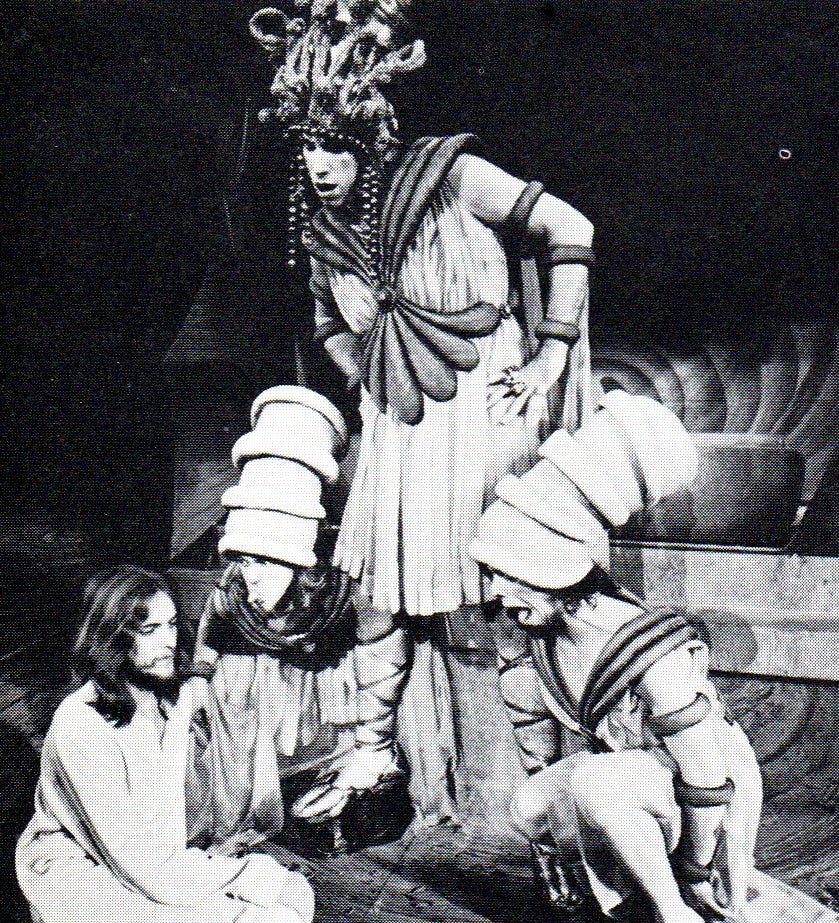
If you came in knowing the original record, you’re expecting to go from one extreme, a boffo vaudeville comic relief number, to another, a broken man quite literally at the end of his rope. But as the roar in the theater subsides, something else is happening.
Yvonne Elliman as Mary, sounding as sensational as on the album, is disclosed kneeling downstage. Next to her is the apostle Peter, played by Michael Jason. A tender piano melody has begun, accompanied by a sustained, soft hum on a single note from the ensemble. Ethereal. Haunting.
The start of a new number, with a simple premise: with Jesus locked in a cell, Mary and the apostles can see that everything they had hoped for has gone horribly wrong. They wish they could turn the clock back and start again.
You are listening, it turns out, to one of the first performances of “Could We Start Again Please?”
Backstory
The song’s origin was largely practical. The original album ran 87 minutes and 16 seconds, considered short by then-contemporary theater standards. Frank Corsaro, who was engaged to direct the production before a car accident landed Tom O’Horgan in the show’s driver’s seat (pardon the unfortunate pun), had discussed lengthening the score with Tim Rice and Andrew Lloyd Webber, making suggestions about restoring music excised from the album, expanding on existing songs, and creating a lovely scene of gentility and respite amid the cruelty of Act II, which eventually became “Could We Start Again Please?”
Though only two of Corsaro’s suggestions ultimately came on board, as expansion went, this was a no-brainer. Lloyd Webber writes in his memoir, “…everyone agreed that we needed a new song for Mary Magdalene. She virtually disappears in the second half of the original album.” Rice concurs in his, adding, “This would not have been satisfactory when we had such a marvelous singer in the part [i.e., Yvonne Elliman] and one who was becoming quite well known.”
Practical though it may have been, it also served a vital structural purpose, easing the transition from Herod’s comic number to Judas’ dramatic suicide. Without it, the mood whiplash is intense; “Herod’s Song,” while a welcome relief from the heavy proceedings on the record (and in any production that otherwise follows the album slavishly, not allowing the audience a second to breathe), is too short a break onstage before we veer back into the drama. Further, much like Stephen Sondheim and John Weidman’s Assassins and the addition of “Something Just Broke” (an apt comparison, as you’ll learn shortly), despite its frequent history of appearing on stage as a spectacular extravaganza, JCS, up to this point, has been — believe it or not — claustrophobic, an intimate drama concerning the mental machinations of a handful of people with occasional intrusions from the chorus, an enclosed world of frustration and exhaustion. What’s missing, especially on the album (though I’ll concede it’s less necessary there structurally), is a musical expression of the outside reality, the emotional impact of what has occurred on (virtually) bystanders with equally significant viewpoints.
Here, for just a moment, Peter and Mary express their desperation and confusion; they don’t understand how things got so out of hand, and they don’t comprehend why Jesus, at least in their perception, has taken things to such an extreme. They are, to quote another Lloyd Webber musical, twisted in every way, rife with emotional and intellectual contradictions, like Jesus himself and his movement: Mary says they’ve been both living to see him and also dying to see him, that they’ve been hopeful but also now pessimistic. Peter and Mary even echo Judas’ opinion that Jesus has gone too far, begging Jesus to stop all this — just as Judas had. A lot of Act II has the feel of an I-told-you-so delivered on a matryoshka level, especially with the repeated melodic motifs, so the same standpoint coming from ardent followers with a completely new melody reinforces that overall point with added impact: he was right, it went wrong.
Though many directors, including (in my opinion) Norman Jewison in the film, don’t appear to know how to stage it, dramatically speaking, “Could We Start Again Please?” is intriguing, perhaps the tenderest moment in JCS.
The Problem
But not everyone agrees. Indeed, a growing group of fans (many of them Brown Album purists) is less than thrilled with the song’s existence; they think Herod is enough relief from the drama and that it doesn’t feel organic to the moment, returning to Mary and Peter out of nowhere.
To name two examples: my friend Alex Tirrell, a musician with a wealth of JCS experience, has complained to me that Herod’s number ends on a high note, with lots of laughs, and he hates having to then slump into a low-energy, boring ballad that slows the momentum and that the audience doesn’t reorient itself quickly enough to process. Adam Schoales, a Toronto-based video producer and editor and aspiring stage director, once said that while I’d persuaded him of the importance of “Then We Are Decided” by merely finding a different placement for the song onstage to help it land better (more about that here), nobody could convince him that “Could We Start Again...” was necessary. Ouch!
Possible Solutions
In my experience as a producer, directors, actors, and musicians alike, to say nothing of audiences, will accept anything, even material for which they don’t especially care, as long as it makes sense. “Make it make sense” is a current phrase I sometimes believe was coined especially for those groups; it may outstrip “What’s my motivation?” in popularity with actors over the next decade.
Over many years of voracious JCS consumption, I’ve seen possible solutions that may help “Could We Start Again Please?” make sense for its detractors, some of which work better than others, including:
Just cutting it. A few productions, like the Ultrasonic Rock Orchestra’s concert version (and accompanying tribute album), have just dispensed with the song. This is the solution that would probably make the detractors I describe happiest, and I’ll admit that in such a context, the show flows well enough without it, but I think taking the easy way out is for quitters. Plus, you can’t change the licensed version of any show without permission, especially an Andrew Lloyd Webber show. The dude is anal about how he wants his work to be performed, and perhaps understandably so, given the treatment JCS received in its initial Broadway production in 1971 when he wasn’t powerful enough to crack the whip. Besides, the authors like it and think it solves a problem, whether or not detractors believe there is one; even if permission was asked, they’re unlikely to sign off on it.
Taking “Could We Start Again Please?” and pushing it somewhere else.1
The nature of this solution is quite plain: repositioning the song, much like I advocate for “Then We Are Decided,” hoping it works better elsewhere. There are two possibilities. First, as discussed previously here, the critically and commercially acclaimed all-star 1992 Australian concert revival moved up “Could We Start Again...” to immediately follow “Peter’s Denial.” This new placement was indeed organic to the moment in that, rather than randomly returning to them, Mary and Peter are already present, hesitant, scared, confused, and no doubt wishing they could change things. However, the lyrics work better later in the story — “I’ve been living to see you...” doesn’t make sense when Jesus has only just been arrested; it takes real feats of directing magic to disguise that and help the song land emotionally (for example, staging the scenes preceding as occurring in such a whirlwind as to completely disorient Mary and Peter, making the sentiment appear less forced). Anyone paying close attention to the lyrics wouldn’t be fooled. Second, the 2005 Dutch cast, no doubt drawing inspiration from the recent success of a similar scene in The Passion of the Christ (and possibly the harrowing shot of a helpless Mary being pulled away from the brutal beating by apostles in the 1973 film), positioned the song in and around the thirty-nine lashes sequence. (Schoales especially likes the latter placement, to which I say, “And that doesn’t kill momentum and pull focus?”)
Building up the scene to make it more dramatically germane. I believe Des McAnuff correctly identified the problem most people have with the song when he directed the 2012 Broadway revival: it veers away from the primary leads at a time when they should be in focus; if you don’t care about the people singing it, it lacks dramatic weight. We care about Mary, sure, but not quite as much as Judas and Jesus; it’s hard for us to give a damn about Peter, who, based on the text alone, has only just established himself as a character (unless, of course, you borrow my idea of combining Simon and Peter into one fully drawn character). McAnuff decided to solve that by making the scene about everybody’s complex emotions at that moment, rather than just Peter’s shame at having denied Jesus and Mary’s heart being ripped out as she realizes what might come next. Bearing in mind his production focused on the triangle between Jesus, Mary, and Judas, he cut the ensemble to make it a more intimate moment and added Judas to the song, assigning much of the second half to just him; we were meant to see this as the moment that pushed him over the edge. It was a bold choice, one he sprung on the authors, sight unseen, when the production originated at Canada’s Stratford Shakespeare Festival and was lucky to get approved. But when I saw and heard it (via bootleg), I thought Josh Young acted and sang it very well, and I liked the idea.
Of the options, I like the third best, but I think we could push it just a step further. Luckily for me, there’s precedent.
The Barua Blueprint
My relentless pursuit of knowledge of the wide world of obscure JCS ideas eventually led me, as it inevitably would have, to Sameer Barua. He joined the JCS Zone Forum after serving as musical director for a 2012 production by the Avondale Theatre Company. Like many before him, he’d received the messy handwritten scores then licensed to amateur presenters, balked at the immense task of trying to make sense out of them, and opted to create bespoke orchestrations and vocal arrangements instead, blending what he liked from various sources, primarily the 1973 film and the Brown Album. As you might expect, his solution to “Could We Start Again Please?” was unique.
In 1992, Tim Rice wrote additional lyrics for a pop version of the song recorded by Paul Nicholas and Claire Moore to promote the original London production’s 20th anniversary (and their concert tour — and tie-in cast recording — celebrating the same). It was not designed to be performed in character and was a bonus track outside the show’s context, both live and on the CD.
I, too, cringe at its ubiquitous early Nineties adult-contemporary arrangement, replete with cheesy background vocals and chintzy synths. You can almost picture it as one of the overly dramatic bordering-on-softcore-porn music videos from that era: wind machines on full blast, feathered hair flying in the artificial breeze, some Harlequin-level bodice-ripping on satin sheets, the works.
In this context, especially, the added lyrics are no great shakes:
Wish I could reassure you
Wish I could talk to you and tell you how I feel
I’ve been very careless
This I don’t deny
But could we start again, please?You surely know I love you
But something in me stands aside and lets you slip away
Perhaps that’s what you wanted
Perhaps I want that too…
Oh, could we start again, please?
The odd JCS production has inserted them over the years, to no discernible profit, but they’ve never been an official part of the show.
Well, leave it to Sameer to look past all of that and figure out a proper use for them. He chose to add these lyrics, assigned to make them “work” in character and context, creating parts in the song for Jesus and Judas. It was a simple insertion, slipped in before Mary sings “I’ve been living to see you...” the second time around: Jesus takes “Wish I could reassure you…” and Judas has “You surely know I love you…”2 (joined at appropriate junctures by Mary and Peter), following which the arrangement returned to the number proper to close.
If embedding with a timestamp works, you can hear the result below; if not, hop over to YouTube for a second (the track tags are in the video description).
I didn’t expect it to pay off, but it did. I was struck not only by how terrific the arrangement was (if a little overloaded with influence from the Nineties track as the song ended, at least for my taste), but also by how well the added lyrics worked in those respective characters’ mouths: the emotion within, who sang what, and why. This seemed like exactly what each person wished they could say if they had time and opportunity. It was, in my opinion, a resolution to all those characters’ arcs, exactly the dramatic weight needed to assuage (some of) the song’s detractors, and perfectly captured the triangle Tim Rice feels is central to the story without neglecting Peter’s feelings.3
This is the drama missing in the Sunday School flannelgraph illustrations: Mary’s painful realization that she has lost forever her chance to express her love to Jesus; the fear, confusion, and loss that Peter and Judas feel; perhaps even a little self-awareness from Jesus of how badly he’d managed the situation on a human level. This is JCS.
And that’s why I love — and recommend — what I call “the Barua blueprint” for “Could We Start Again…”
Bonus: My Staging
Since I’m finally making moves toward directing this show, indulge me for a second as I fiddle about with this version of the scene.
If I may direct from the page for a moment, picture a stage divided into three areas: Mary, Peter, and disciples in one place, Judas in another, and Jesus in a third, like the 2000 film but more abstract and less “police brutality ballet,” with isolated people and groups sharing the same emotion in three different places, clearly delineated as occupying separate spaces while sharing the stage — the focus being a release of emotion, a “check” on where they’re at, internally.
As it opens, Jesus is beaten, a wreck, on the floor, and perhaps we perceive the start of the scene as if Jesus is merely imagining the other people or feeling their pain from a distance. Then he sings “Wish I could reassure you…” When he finishes singing, the guards take him away, and we are left to hear the others. This is now their reality; ditto Judas, who gives us “You surely know I love you…” echoed at points by Mary and Peter.
The ending, though, is the real kicker. “If one must borrow, borrow from the best” did not become an axiom for no reason. Instead of building to that overly pompous finish from ‘92, I restore the original ending… with a twist. I’d use the segue from this clip of the early-Aughts national tour, the “again” held over the intro of “Judas’s Death.” Talk about a gut punch to bring the audience back to earth.
That’s it, for me at least. But what do you think? Sound off in the comments!
I’m a Nineties kid raised on Nickelodeon. I’m not apologizing. If you don’t get the reference, ask your kids; I’m not here to do all your homework for you.
Before you ask, yes, Judas is played by a female performer (ostensibly as a female character) in the video. The creative team found the (possible) subtext of Judas competing with Mary for Jesus’ love and attention touchy enough that they decided to sidestep both homophobic reactions and queer-baiting accusations by a) casting a cis woman as Judas, and b) creating a setting so alien from the Bible that it took people’s minds off of equating the behavior they saw with anyone depicted in a stained glass window, allowing this subtext to be more directly addressed. There are certainly worse ways to handle such a situation.
If anything, my notion of combining Simon and Peter would only make said feelings more significant, but I digress.